You Won’t Believe What I Found at Jakarta’s Hidden Festivals
I went to Jakarta expecting traffic and skyscrapers — not soul-stirring traditions. But behind the city’s chaotic vibe, I discovered something raw and real: local festival culture alive in backstreets and neighborhoods. From drumbeats at dawn to streets lit with handmade lanterns, these aren’t tourist shows — they’re private moments of pride, faith, and community. This is Jakarta beyond the guidebooks. Let me take you where the real celebrations happen — intimate, unfiltered, and unforgettable.
The Jakarta No One Talks About
Jakarta is often portrayed as a sprawling metropolis defined by its relentless traffic, towering glass buildings, and fast-paced urban life. International travelers passing through may see only the surface — the honking motorbikes, the heat, the endless flow of people moving from one mall to another. Yet beneath this modern exterior lies a Jakarta few outsiders ever witness: a city pulsing with cultural memory, where centuries-old traditions are not preserved behind museum glass but lived and breathed in quiet alleyways, neighborhood courtyards, and community halls.
What makes these traditions remarkable is their authenticity. Unlike staged performances for tourists, the festivals celebrated in Jakarta’s residential pockets are deeply rooted in local identity. They emerge not from tourism boards or corporate sponsors, but from the collective will of families, religious groups, and neighborhood councils who gather not for spectacle, but for continuity. These events are acts of preservation — a way for communities to pass down values, stories, and rituals to younger generations in a city that changes faster than memory can keep up.
For many residents, festival culture is more than celebration — it is emotional grounding. In a city where land is constantly repurposed and neighborhoods are reshaped by development, these gatherings offer stability. They remind participants of who they are, where they come from, and what they share. To witness them is not simply to observe a custom, but to step into a living heritage — one that thrives quietly, resiliently, in the heart of one of Asia’s most dynamic capitals.
Pasar Malam: More Than Just Night Markets
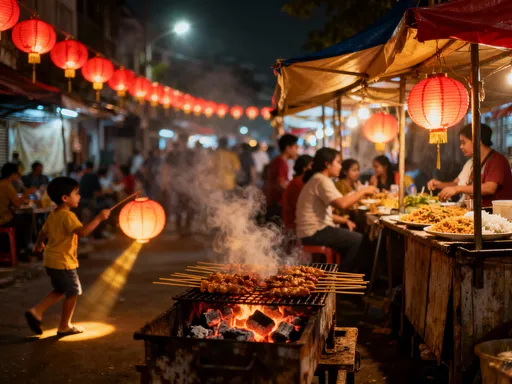
One of the most vivid expressions of Jakarta’s hidden festival life unfolds each evening during the holy month of Ramadan — the Pasar Malam, or night market. These are not ordinary markets. As daylight fades, entire streets in neighborhoods like Tanah Abang, Cipulir, and Kemayoran transform into bustling corridors of light, scent, and sound. Temporary stalls rise like tents, selling everything from steaming bowls of bakso to intricately woven prayer mats. The air fills with the sizzle of satay grilling over charcoal, the sweetness of es campur, and the floral aroma of jasmine tea poured from large glass dispensers.
But Pasar Malam is more than a shopping experience — it is a social ritual. Families arrive after breaking their fast together, children clutching small lanterns shaped like stars or mosques, their faces glowing under strings of colored lights. Elders sit on plastic chairs arranged near food stalls, sipping warm drinks and exchanging stories. Young couples stroll hand in hand, while vendors call out specials in rhythmic cadences. The market is not just a place to buy food; it is where relationships are nurtured, news is shared, and community is reaffirmed.
What makes these night markets especially meaningful is their impermanence. They appear for only a few weeks each year, disappearing as quickly as they came, leaving behind only memories and the faint scent of grilled meat in the morning air. Yet during their brief existence, they become the heartbeat of the neighborhood — a shared space where economic activity and emotional connection intertwine. For visitors lucky enough to experience them, Pasar Malam offers a rare glimpse into the rhythm of daily life in Jakarta, where celebration and survival are often part of the same breath.
Semarak Budaya: When the Neighborhood Takes Over
In Jakarta, festivals are not always grand citywide events. Some of the most powerful celebrations happen at the grassroots level — organized not by government agencies, but by local neighborhood groups known as RT (Rukun Tetangga), or “Mutual Assistance Units.” These community-led initiatives bring entire blocks together for cultural festivals known locally as Semarak Budaya, or “Cultural Vibrancy” events. Held to mark national holidays like Earth Day, Independence Day, or Jakarta’s own anniversary, these gatherings turn quiet residential streets into stages of tradition and togetherness.
Picture a narrow lane in East Jakarta, usually filled with parked scooters and laundry lines, now strung with red-and-white flags and paper lanterns. Children in traditional costumes perform the Tari Yapong, a dynamic Betawi dance marked by sharp hand movements and joyful expressions. Elderly residents lead processions carrying banners that read “Gotong Royong” — a core Indonesian value meaning mutual cooperation. Music from angklung ensembles and keroncong bands drifts through the air, while long tables are set up for communal meals featuring dishes like kerak telor and soto Betawi.
These events are unscripted, unpolished, and profoundly moving. There are no VIP sections, no media crews, and rarely any foreigners in sight. Participation is organic — neighbors help set up chairs, parents record videos on their phones, and grandparents recite poems in the local dialect. The emphasis is not on performance, but on presence. It is in these moments that the true spirit of Jakarta reveals itself — not in grand monuments, but in the quiet dignity of people coming together simply because they live side by side.
Semarak Budaya events are also acts of cultural preservation. In a city where modernization often means erasing the old to make way for the new, these festivals serve as reminders of what might otherwise be forgotten. They teach children the dances, songs, and values of their ancestors, ensuring that identity is not lost in the rush toward progress. To witness one is to understand that community, in its purest form, is not built by policy — it is grown, slowly and steadily, through shared celebration.
Chinese New Year in Glodok: A Private Celebration in Public
Walking through Glodok, Jakarta’s historic Chinatown, during Lunar New Year is an experience of layered meanings. On the surface, it is a dazzling display of red lanterns, lion dances, and bustling crowds. Storefronts are draped in gold and crimson, children wave sparklers, and the scent of roasted duck and mandarin oranges fills the air. Tourists snap photos, drawn to the vibrancy, but few realize that beneath this public spectacle lies a deeply personal and spiritual observance.
For Jakarta’s Chinese-Indonesian community, the New Year is not merely a cultural festival — it is a sacred time of renewal, family reunion, and ancestral remembrance. Inside homes and private temples, families place offerings of fruit, tea, and incense before ancestral altars. Prayers are whispered in Hokkien or Mandarin, and elders recount family histories to younger members. Some temples, such as Vihara Dharma Bhakti, limit entry during certain ceremonies to devotees only, emphasizing that this is not a performance, but a moment of devotion.
The lion dance, often seen as entertainment, follows strict ritual protocols. The movements are believed to ward off evil spirits and invite prosperity, and the dance is performed only after purification rites. Red couplets hung on doors are not decorative — they carry poetic blessings written in classical Chinese, expressing hopes for health, harmony, and good fortune. Even the act of giving angpao (red envelopes) is governed by tradition, with specific rules about who gives and who receives.
For outsiders, the lesson is clear: respect the boundary between public display and private meaning. While it is acceptable to observe the festivities in the streets, entering homes or restricted temple areas without invitation is inappropriate. The true beauty of Glodok’s Lunar New Year lies not in its colors or noise, but in its quiet moments — a grandmother lighting incense, a child receiving her first angpao, a family gathered around a reunion dinner. These are not moments for spectacle, but for reflection — a reminder that even in the most visible celebrations, intimacy endures.
Betawi Festivals: The Heart of Jakarta’s Identity
If Jakarta has a soul, it speaks in the rhythms of Betawi culture — the indigenous heritage of the city’s original inhabitants. Though often overshadowed by Jakarta’s modern image, Betawi traditions remain a vital force, especially during the city’s annual anniversary celebrations in June. Across districts like Setu, Marunda, and Condet, communities come alive with music, dance, and storytelling that trace back generations. These festivals are not reenactments — they are affirmations of identity in a city that has changed beyond recognition.
Central to these celebrations is gambang kromong, a traditional ensemble blending Malay, Chinese, and European influences, featuring xylophones, violins, and drums. The music is lively, melodic, and instantly recognizable to locals. Equally iconic are the ongkek dancers — performers in vibrant masks and flowing costumes who move in rhythmic procession, often parodying colonial figures or social types in a form of gentle satire. Their dances are not just entertainment; they are historical commentary, passed down through oral tradition.
Equally important are the quieter rituals, such as the recitation of silsilah — genealogical records that connect families to their ancestors and to the land. In a city where old homes are demolished for high-rises, these recitations are acts of resistance. They assert continuity. They say, “We were here before the skyscrapers, and we remain.” Traditional attire, such as the baju sadariah for men and kebaya encim for women, is worn with pride, not as costume, but as heritage.
What makes Betawi festivals so powerful is their dual nature — they are joyful and solemn, festive and defiant. They celebrate survival. In preserving language, music, and customs, the Betawi people remind Jakarta of its roots. To attend one of these events is to witness not just culture, but courage — the quiet determination to keep a way of life alive, even when the world around it moves in another direction.
How to Experience These Festivals Respectfully
For travelers seeking authentic cultural experiences, Jakarta’s hidden festivals offer unparalleled depth. But with that opportunity comes responsibility. These are not tourist attractions designed for consumption — they are community events rooted in faith, tradition, and belonging. To participate, even as an observer, requires humility, patience, and respect.
The first step is knowing how to find these events without intruding. Many are not advertised online or in guidebooks. The best way to learn about them is through local connections — a homestay host, a neighborhood guide, or a community center worker. If invited, treat the invitation as a privilege, not a right. Arrive on time, dress modestly, and observe quietly before engaging. In many cases, simply being present — without taking photos or demanding explanations — is the most respectful form of participation.
Language matters. Learning a few basic phrases in Bahasa Indonesia, such as “Terima kasih” (thank you) or “Boleh saya lihat?” (May I watch?), goes a long way. In Betawi communities, even a simple greeting in the local dialect can open doors. Avoid loud or disruptive behavior, and never touch ritual objects or enter restricted areas without permission. Remember, these spaces are sacred to those who gather there.
Support the community in tangible ways. Purchase food from local vendors, donate to event funds if invited, and avoid treating people as photo subjects. Ask permission before taking pictures, and if someone declines, accept it gracefully. The goal is not to capture the perfect shot, but to honor the moment. When travelers approach these festivals with curiosity rather than entitlement, they become part of the story — not as outsiders, but as guests welcomed into a shared human experience.
Why These Moments Matter Beyond Tourism
Jakarta’s hidden festivals are not just cultural curiosities — they are acts of resilience. In a world where cities grow more homogenized by the day, where global chains replace local shops and digital life displaces face-to-face connection, these gatherings stand as quiet declarations of difference. They say that identity cannot be erased by progress, that community is not obsolete, and that tradition has a place even in the most modern of capitals.
These festivals also challenge the way we think about travel. In an age of social media, where experiences are often reduced to likes and hashtags, Jakarta’s celebrations invite a different kind of engagement — one that values presence over performance, listening over capturing. They remind us that the most meaningful journeys are not about seeing more, but about understanding deeper. To witness a child dancing in a neighborhood festival, or an elder leading a prayer, is to touch something universal — the human need to belong, to remember, and to celebrate.
On a broader level, Jakarta’s festival culture reflects a global struggle — the effort to preserve identity in the face of rapid urbanization. From Seoul to São Paulo, cities are grappling with how to honor their roots while moving forward. Jakarta’s answer lies in its streets, in the way communities come together not because they must, but because they choose to. These festivals are not resistance for the sake of opposition — they are love letters to heritage, written in music, food, and shared silence.
For every traveler who has ever wondered if authenticity still exists, Jakarta offers proof. It is not in the polished attractions, but in the unscripted moments — a drumbeat at dawn, a lantern swaying in the breeze, a grandmother’s smile as her grandchildren perform a dance she once knew by heart. To experience these festivals is to remember that culture is not something we consume — it is something we protect, together. And in that protection, we find not just history, but hope.